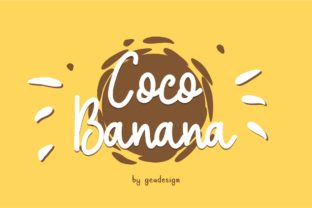
Coco Banana Font: Fresh Handwritten Style for Web Design
When designing digital experiences that need to feel personal, approachable, and distinctly human, standard system fonts often fall short. As web designers and UI creators, we constantly search for typography that bridges the gap between professional polish and authentic personality. Coco Banana is a handwritten font that delivers exactly this balance. It offers an incredibly fresh and fun feel without sacrificing the structural integrity required for modern web layouts. Unlike overly ornate script fonts that struggle on screens, this typeface maintains legibility while injecting warmth into hero sections, landing pages, and brand assets.
Digital Readability and Visual Hierarchy
The primary challenge when integrating a handwritten font into a website is ensuring it does not compromise user experience. Coco Banana succeeds because its letterforms are open and distinct. In web design, visual hierarchy guides the user’s eye through content, and display typography plays a critical role in this scanning behavior. This font works exceptionally well as a high-impact heading or accent element rather than body copy. Its unique character shapes create natural focal points that draw attention to key messages, value propositions, or promotional banners.
For UI designers working on responsive layouts, readability on mobile devices is non-negotiable. Coco Banana retains its charm even when scaled down for tablet or smartphone screens, provided it is used appropriately. When implementing this font in CSS, consider increasing line-height slightly more than you would for a geometric sans serif. Handwritten styles often have varying ascender and descender heights, and adequate vertical spacing prevents characters from feeling cramped against one another. This small adjustment ensures the playful rhythm of the typeface translates smoothly across all viewport sizes.
Strategic Applications in Web Layouts
Versatility is key for any premium font added to a digital toolkit. Coco Banana fits naturally into several specific web contexts where tone matters as much as information:
- Hero Sections: Use it for the main headline to immediately establish a friendly, creative brand voice before the user scrolls.
- Call-to-Action Accents: Pair it with button text or directional cues like "Shop Now" or "Learn More" to make interactive elements feel inviting rather than transactional.
- Product Highlights: In e-commerce stores, use it for badges, sale tags, or short product descriptors to add a boutique, handcrafted aesthetic.
- Blog and Content Headers: Break up long-form editorial content with subheadings in Coco Banana to maintain reader engagement and reduce visual fatigue.
- Social Media Graphics: Create consistent branded templates for Instagram stories or Pinterest pins that align perfectly with your website’s typography.
These applications leverage the font's personality to enhance conversion-focused layouts. By making digital interfaces feel less sterile, you build emotional connections that can positively influence user trust and dwell time.
Font Pairing for Professional Digital Identity
A standalone decorative font rarely builds a complete design system. Effective font pairing is essential for maintaining professionalism while using a playful typeface like Coco Banana. The goal is contrast; let the handwritten font be the star while a supporting typeface handles the heavy lifting of information delivery.
For most modern web projects, pairing Coco Banana with a clean, neutral sans serif font is the safest and most effective strategy. Typefaces like Inter, DM Sans, or Outfit provide the necessary stability and readability for body text, navigation menus, and footer links. The geometric simplicity of these sans serifs allows the organic curves of Coco Banana to pop without creating visual chaos. Alternatively, for brands aiming for a more sophisticated or editorial digital identity, a classic serif font can create a beautiful tension between tradition and playfulness. This combination works particularly well for lifestyle blogs, coaching websites, or artisanal online shops.
When establishing your CSS variables or design tokens, define clear roles for each font. Reserve Coco Banana strictly for display purposes—typically h1, h2, or specific highlight classes. Keep your functional typography consistent and predictable. This discipline ensures that the playful nature of the script enhances the brand identity rather than undermining usability.
Technical Considerations and Accessibility
Integrating custom fonts requires attention to technical performance and accessibility standards. When loading Coco Banana via @font-face or a web font service, always include fallback stacks that mimic the x-height and width of the intended typeface. This prevents Cumulative Layout Shift (CLS) during page load, which is vital for both SEO and user experience. Additionally, check the included file formats; WOFF2 is currently the industry standard for web performance due to its superior compression.
Accessibility extends beyond code to visual presentation. While Coco Banana is legible for a handwritten style, it should never be used for critical interface text like form labels, error messages, or legal disclaimers. Always ensure sufficient color contrast when placing this font over images or colored backgrounds. The irregular strokes of handwritten letters can sometimes blend into busy photography, so applying a subtle text shadow or semi-transparent overlay behind the text can preserve readability. Furthermore, respect user preferences by allowing browser zoom functions to work correctly; avoid setting font sizes in fixed pixels for headings, opting instead for relative units like rem or clamp() functions for fluid typography.
Licensing and Commercial Usage
As digital product creators and agency designers, understanding licensing is as important as understanding kerning. Before deploying Coco Banana on a client site, e-commerce store, or digital template, verify the specific license terms. Most commercial font licenses distinguish between desktop use (for creating static graphics) and webfont use (for embedding in live websites). Some licenses may also have tiered pricing based on monthly page views or the number of domains.
If you are building templates for marketplaces or creating digital products for resale, ensure your license covers redistribution or end-product usage. Proper licensing protects both you and your clients from legal issues and supports the type designers who create these valuable assets. Investing in the correct license is a mark of professional integrity and ensures your project remains compliant as it scales.
Ultimately, Coco Banana serves as a powerful tool for web designers seeking to differentiate their work in a crowded digital landscape. Its fresh, handwritten aesthetic solves the problem of generic corporate design while remaining functional enough for real-world application. By treating it as a strategic component of your visual hierarchy—paired thoughtfully, implemented accessibly, and licensed correctly—you can create web experiences that feel genuinely human and memorably distinct.